
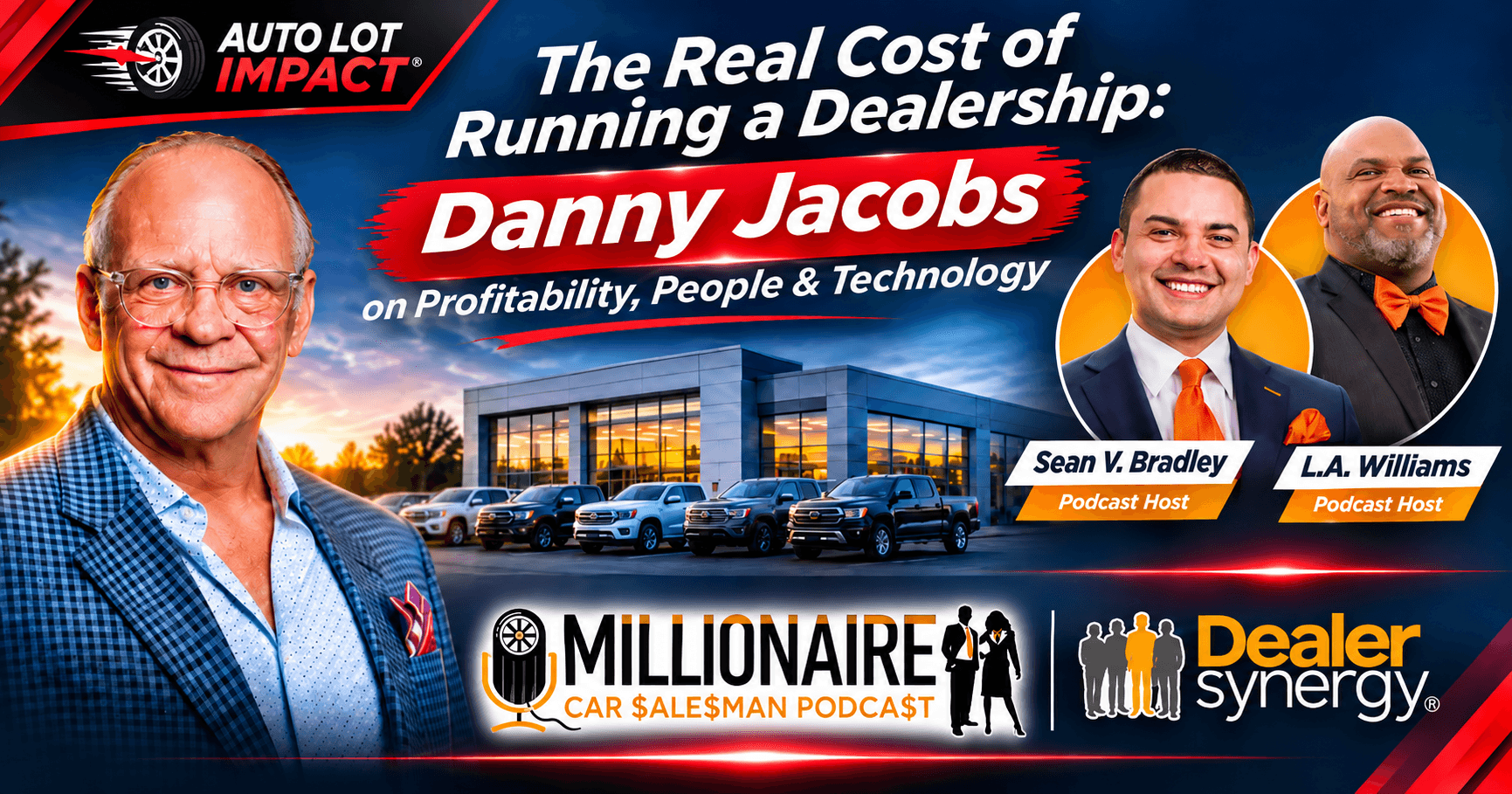
What does dealership profitability really look like when operating costs keep climbing, customers shop differently, and every new piece of technology promises to be the answer?
Few people are better placed to answer that than Daniel “Danny” Jacobs. Danny has spent 36 years in the car business, as a wholesaler, a manager and a franchise dealer principal, and he now leads Auto Lot Impact.
Danny recently joined hosts Sean V. Bradley and L.A. Williams on the Millionaire Car Salesman Podcast to talk about what it takes to run a profitable dealership today, how car buyers have changed, and where technology does and doesn’t earn its place.
🎥 Watch the full episode on YouTube · 🎧 Listen to the podcast
From wholesaling to dealer principal: 36 years in the car business
From there, he wholesaled for a Lexus franchise, ran its Akron store as a manager, and went back to wholesaling.
In 2014, seeing how quickly the automotive industry was changing, Danny and a partner began the process of acquiring an underperforming Mazda dealership. They officially took ownership in 2015 and turned the store around within six months. The dealership later went on to become a Gold Cup dealer.
A Chevrolet dealership followed, then a Buick GMC store, and for years Danny moved between dealerships, managing the daily realities of running a profitable automotive business.
Along the way, he and his team developed software to solve a problem they were experiencing in their own stores. When it proved successful, they shared it with other dealers they knew. That solution eventually became Auto Lot Impact.
The cost of opening the doors
Asked about the biggest challenges facing a dealer principal, Danny put it plainly: you are running five businesses that have to come together at the end of the month to turn a profit.
For a small franchise dealership, he estimates $150,000 to $300,000 just to operate before you see a profit. Technology costs a fortune. People cost a fortune. And meanwhile factories cut margins, there is less profit in each vehicle, and shoppers compare everyone on price.
The hidden cost of every car on the lot
Then there is the inventory itself. Most vehicles are bought on floor plan, a bank loan where interest starts on day one. For franchise dealers it can start even earlier: Danny described paying interest on vehicles that were still on a boat from overseas.
He put real numbers on it. A Silverado can cost around $80 a day to hold. Keep it for 90 days, and a deal that looks like $2,000 of front-end gross can actually lose $3,000 once holding and selling costs are counted. His rule of thumb: a car makes its profit in the first 15 days, earns perhaps 30% of that between days 15 and 30, and by 60 days it is losing money. With interest rates up, that window keeps getting shorter.
Accountability without micromanagement
Danny’s answer to that pressure is clear goals and daily visibility. At his own dealership, he ran a “rate of travel” check: each manager spent five minutes at the end of the day pulling a few metrics from the DMS. At a glance, he could see where the store was short, whether on repair orders, ups or parts counter sales, and point his managers straight at the gap.
“A team effort is going to do a lot better than a sole effort,” he said, adding that a dealer principal trying to wear every hat will never control it all.
The customer has changed. Customer service still matters.
When Danny started, buying a car meant driving lot to lot, picking up an Auto Trader magazine at the grocery store or gas station, or seeing a TV commercial. Today the average shopper visits only about one and a half dealerships before buying, and often arrives knowing more than the salesperson.
“If you’re not in front of people where they are swiping, you don’t even exist.”
For sales teams, that means the up bus isn’t coming like it used to. Leads come from social media and third-party sources, and salespeople have to build presence and trust before the customer ever walks in.
The BDC is often the customer’s very first contact, and Danny wants that team to know the real inventory.
A shopper asking about safety features deserves an answer about the blind-spot monitoring on that exact vehicle, not a generic email. Leads also arrive at 10 PM, long after the store has closed, so speed matters, but he still wants the response to feel personal.
But Danny is clear that this is still a people business.
Everybody wants to be taken care of, and price alone is a race to the bottom.
“I think people will pay for customer experience.”
He pointed to industry estimates that a customer can be worth over half a million dollars across their lifetime.
Win a 20-year-old’s first car, service it well, and you can earn their spouse, their kids and their family.
That is why Danny invested in his service department and his community.
At his Chevrolet store, he brought in students from a nearby automotive technology school and developed them into certified technicians.
Technology has to earn its place
Danny doesn’t dismiss technology. He says it has helped in every part of the dealership, from the service lane and parts to the office, sales and automatic responders. His point is that all of it costs money, and with vehicle profits shrinking, every tool has to justify itself.
“Unless it’s doing something for your bottom line, what’s the point of making it shiny and sparkle?”
Why a car dealer built software
Danny is the first to say he isn’t a Silicon Valley software guy. “I’m a dealer and I’m a car guy and I had real problems,” he said.
Auto Lot Impact came from solving those problems, not from setting out to invent software.
The first problem was visibility. By Danny’s research, around 95% of dealers don’t show their inventory consistently every day on social media.
Most dealership pages are thank-you posts and photos of customers with their new car, even though social media is becoming the number one place in-market shoppers look.
The second was competing on budget. His Chevrolet store was 30 miles off the highway, up against big dealer groups spending hundreds of thousands of dollars a month on advertising. Third-party listing sites returned 1 to 3% for him, while shoppers who reached his own website closed at 8 to 20%. He couldn’t afford a $1,000 Silverado click, so he needed a way to reach in-market shoppers organically and bring them to his own site.
He took the problem to a developer who had worked with him for around 17 years, and the system they built worked.
His Chevrolet store grew to 8,300 followers in a town of about 4,000 people. When he shared the system with a small used car lot, that dealer started seeing shoppers arrive from 25 miles away who hadn’t known the lot existed.
Non-follower traffic ranged from 42% at worst to 83.6% at best, with zero dollars in ad spend.
How Auto Lot Impact works
Getting started takes a few clicks. Auto Lot Impact connects to the dealership’s inventory feed and needs no admin access and no DMS access, so proprietary information stays secure.
When a new vehicle arrives in the feed, AI researches the most-searched features of that exact vehicle.
The post is built on the dealership’s own custom branded template, published directly to its social media, and tagged so that clicks go straight to the vehicle’s page on the dealer’s website. Leads are then handled through the dealership’s CRM as usual.
A set of triggers keeps everything accurate:
- Price changes: when a price changes, the vehicle is reposted with the new price, and the price history is stored as a record.
- Sold vehicles: posts come down once the car sells, so nobody calls about a car that’s gone.
- Aging inventory: triggers built around older units, the ones costing the most to hold.
- Compliance: features such as doc fee disclosures help keep the dealer out of trouble.
A dashboard then shows paid against non-paid campaigns, clicks and attribution, at the same level dealers expect from third-party services.
Consistency is the key
Danny closed with the point that ties it all together:
“Somebody gets fired, somebody didn’t show up, somebody got too busy, somebody just didn’t want to do it that day. There’s 400 reasons why you don’t consistently show up every single day.”
Auto Lot Impact exists to fix exactly that, so a dealership’s inventory shows up every day, whatever is happening in the store.
Watch or listen to the full episode
Millionaire Car Salesman Podcast, Episode 12:16: Stop Buying Your Traffic: Turn Your Inventory into Lead Magnets Without Spending a Dollar on Ads
Want to see what automated inventory marketing looks like on your own lot?
Book a demo at AutoLotImpact.com
We Put Your Lot in Their Pocket!